Video Streaming
When free isn’t free: Looking beyond the price tag of streaming technology.
October 2, 2026

If you’re building or expanding a streaming product, there’s a good chance you’ll eventually face a choice between a technology with a clear price tag and one that appears to come free. Maybe a video player gets bundled into a larger platform agreement, or a capability you need is already available through a vendor you’re paying. When you’re trying to get more content in front of viewers without letting development costs balloon, the appeal is obvious. Why pay separately for something you can get at little or no additional cost? Sometimes that really does turn out to be the best option. The challenge is figuring out whether the zero on the proposal reflects what the technology will actually cost your business.
Mark McKenna, Director of Client Engineering at REDspace, has seen that question come up regularly in technology decisions. A product can be free from the perspective of the person choosing it while still creating costs elsewhere in the organization. As Mark put it, “The organization is still paying. But I don’t have to pay.”
For streaming leaders, that distinction becomes especially important because the cost of delivering video rarely lives in one place. The technology has to be integrated into an application, supported across the devices your audience uses, and maintained as those platforms evolve. Looking beyond the initial price helps you understand what you’re actually committing to.
Free depends on where you’re standing.
Consider a broadcaster evaluating two technologies for a new streaming app. One comes with an additional licensing fee, while the other is included in an existing vendor relationship. On the surface, the comparison looks straightforward, especially if the person making the decision owns the software budget. The bundled option may genuinely cost that team nothing extra. Implementation work, however, could still fall to engineering, while ongoing infrastructure usage appears in a different part of the company’s budget. And over time, maintenance work may become part of the normal development workload and never show up as a neat line item attached to the original technology decision.
This is where a free option can become difficult to evaluate. A paid product gives you a visible number that’s easy to put into a spreadsheet, while the costs surrounding a bundled product can be spread across the business. None of those costs automatically make the free option a bad choice. They simply need to be included in the comparison. A technology that saves $50,000 in licensing fees could still be the lower-cost choice after implementation and operating expenses are taken into account. The same product could also consume enough engineering time or infrastructure resources that the initial savings disappear.
Mark’s advice is to look beyond what the technology costs at the moment you buy it. “What’s it cost now? What’s it cost in X years?” he asks.
For a streaming business, that means thinking about the life of the product rather than a single procurement decision. Your app may need to support multiple generations of connected TVs, set-top boxes, mobile platforms, and whatever comes next. A technology choice that looks inexpensive today can become much more costly once your team has lived with it through several years of platform changes.
The price tag is only the visible part.
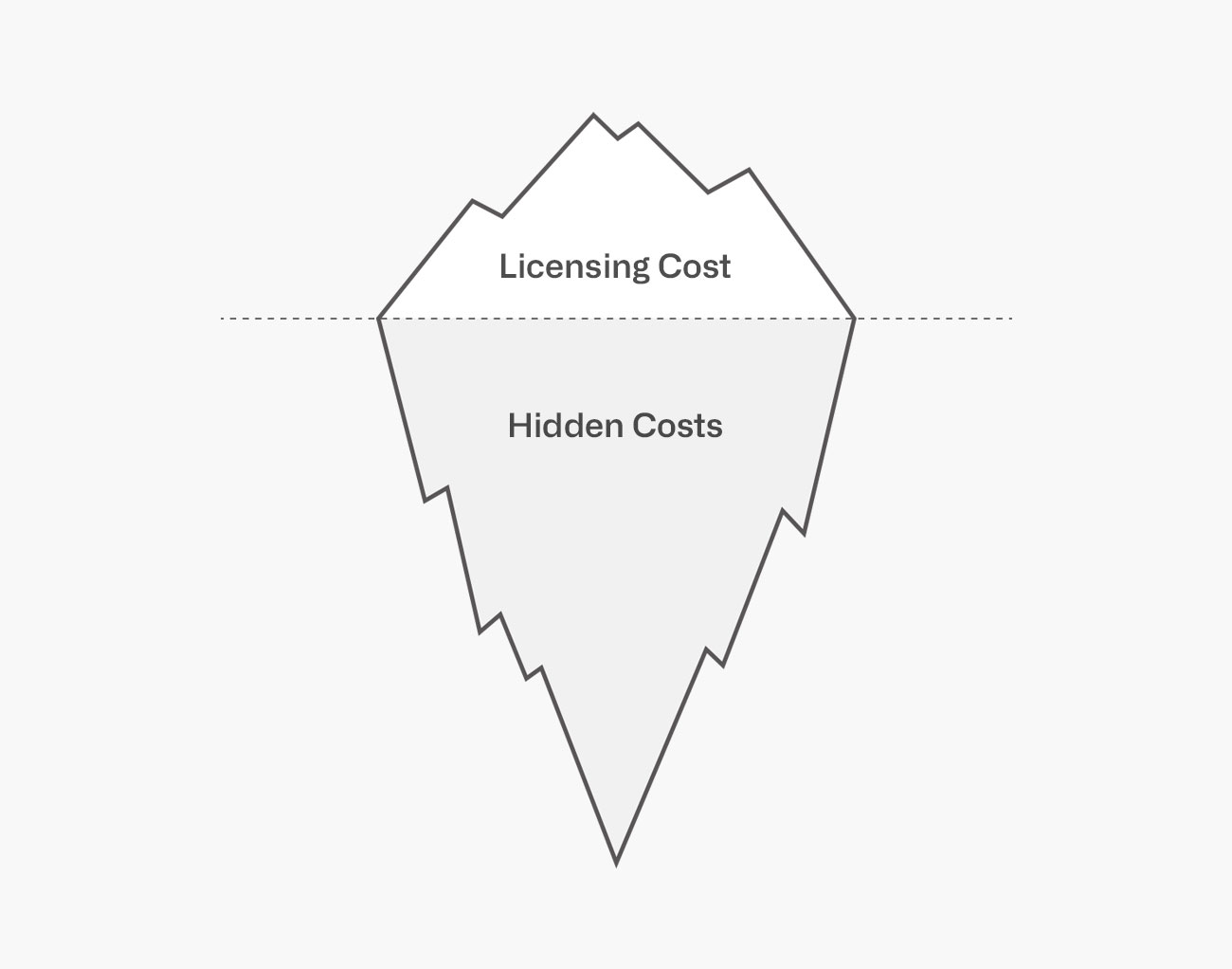
One way to think about the decision is as an iceberg. The licensing fee sits above the waterline because everyone can see it. Underneath are the costs created by integrating the technology into your product, operating it at scale, and keeping it working as your streaming service evolves. A free product can remove the most visible part of the iceberg while leaving much of what sits underneath untouched. The difficult part is estimating how large that submerged portion could become before you commit.
Technical risk belongs below the waterline as well. A vendor may support the platforms listed in your requirements, but “support” can mean different things once an engineering team starts working through specific devices and use cases. Streaming apps live in a fragmented environment where two devices in the same broad platform family can behave differently, and seemingly small limitations can become expensive once development is underway. A regional broadcaster whose audience watches primarily on connected TVs has a different risk profile from a sports organization whose viewers frequently move between mobile devices and living-room screens. The technology needs to work in the environment your audience actually uses.
There’s also the longer-term relationship with the technology provider to consider. A capability that represents a major part of one vendor’s business may receive a different level of attention than a small feature inside a much broader portfolio. That doesn’t make either type of provider inherently safer. Larger vendors may bring tremendous scale and years of experience solving difficult delivery problems, while more specialized providers may offer deeper focus on a particular part of the streaming stack. What you need to understand is how your requirements fit into the provider’s product today and how confident you are that the fit will continue.
Before you choose “free,” ask a few harder questions.
A full evaluation doesn’t need to turn every technology decision into a six-month procurement exercise. It does, however, require getting specific about the business case before the apparent savings start driving the decision. For a streaming leader, the goal is to connect the technology back to the people you’re trying to reach and the experience you need to deliver. These questions can help:
- What will this cost us over the life of the product? Look beyond licensing and estimate the engineering work required to integrate and maintain it. Include the operating expenses that will grow as viewership increases.
- Where will those costs show up inside the organization? A product can be free to your budget while another team absorbs the work required to support it. Talking to the people who will build and operate the service can expose costs that won’t appear in the original proposal.
- Which devices and viewing experiences are essential to the business case? Start with your audience rather than a generic platform checklist. If a meaningful share of your viewers relies on a particular generation of smart TVs or set-top boxes, make sure the technology can deliver the experience you need there.
- What can the vendor demonstrate today? If support for a device or capability is central to your streaming strategy, ask to see it working. A proof of concept using your content can reveal far more than a feature list, especially when the requirement involves older hardware or a complicated delivery environment.
That last question is particularly useful because there can be a large gap between a capability that exists today and one a vendor is confident it can build. Both can be reasonable depending on the project, but they carry different levels of uncertainty. The more important a requirement is to your audience or revenue model, the more valuable it becomes to see evidence before you commit. For streaming products, a working demonstration can uncover technical constraints while there’s still time to change course.
Free can still be the right choice.
After going through this exercise, the free option may still come out ahead. A bundled technology could have lower operating costs, fit neatly into your existing stack, and already work across the devices your audience uses. In that case, the zero-dollar price is a genuine advantage.
The important part is knowing what sits behind that zero. Streaming technology decisions tend to live for years, long after the original purchasing conversation is over. Looking at the full cost and testing the assumptions behind the business case gives you a much clearer picture of what you’re signing up for.
Free can be a great deal. You just want to know what you’re actually getting.
Make the right choice for your streaming app.
REDspace helps media companies evaluate, build, and evolve streaming experiences with the business and technical realities in mind. If you’re weighing technology options for a new or existing streaming product, we’d be happy to talk through what you’re trying to accomplish.