AdTech
From AI experiments to production AdTech.
October 29, 2026

AI experimentation in advertising is relatively easy to start. Teams can test new creative workflows, summarize campaign performance, generate recommendations or automate individual tasks without changing much of the surrounding environment.
Production is different.
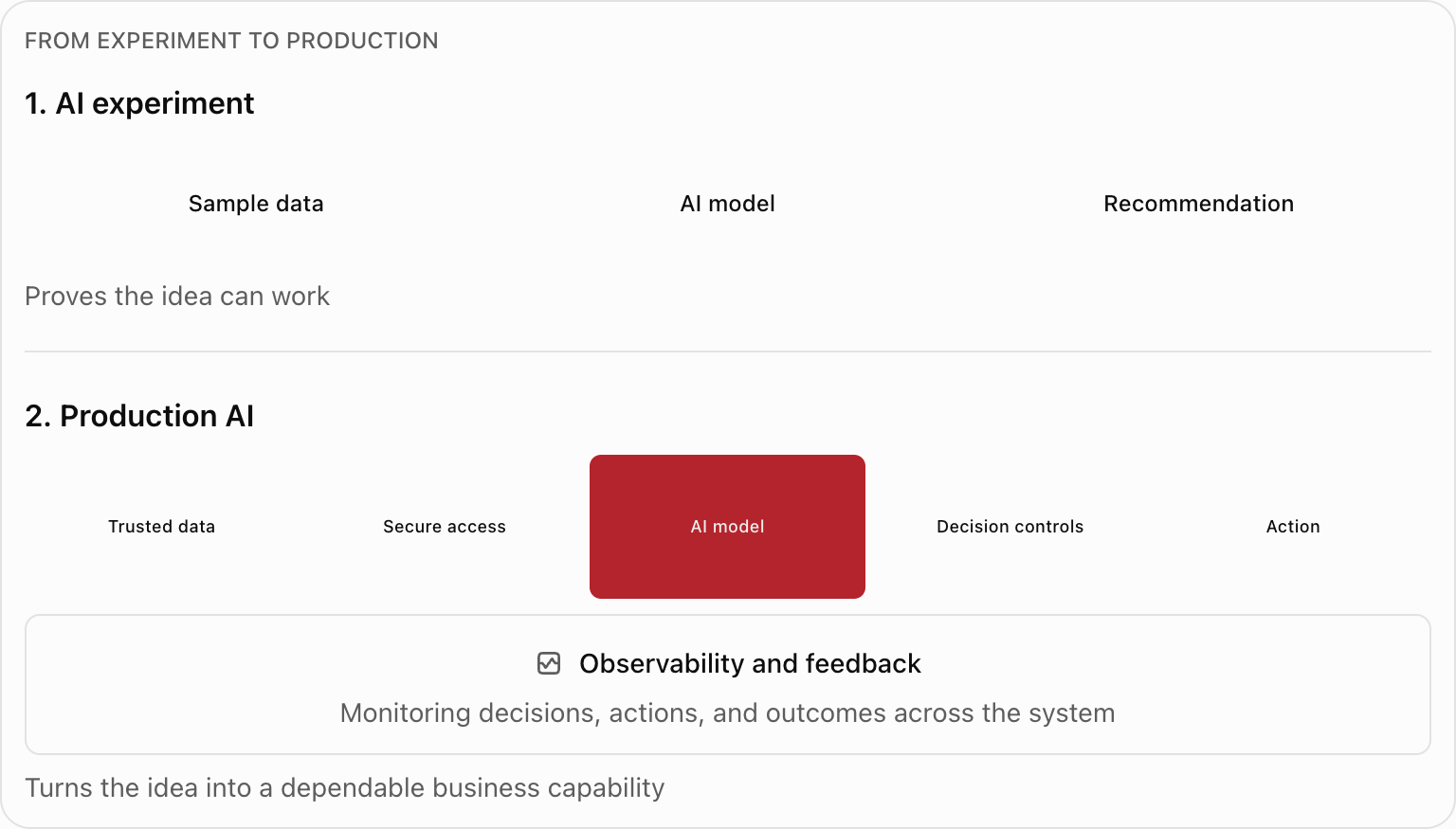
The moment AI begins operating inside real media and advertising systems, the problem changes. Now the organization has to think about trusted data, system access, permissions, observability, governance and what happens when the AI gets something wrong.
In media environments, the real AI bottleneck is often not intelligence. It is access to the systems, context and decision rights required to act safely.
That is where experimentation ends and real production engineering begins.
The model is only one part of the system.
A good AI demo can make a capability look almost finished. A model can identify an anomaly, summarize campaign performance or recommend a next action in seconds.
But production environments rarely give the model everything it needs in one place.
Campaign data may sit in one system, audience data in another, content metadata somewhere else and measurement across several additional platforms. Some of that data may be real-time, some delayed, and some subject to different permissions or business rules.
If the AI is expected to act, the requirements increase again. It may need permission to change a campaign, adjust a configuration, trigger a workflow or interact with a cloud service. Those actions need limits, approvals and logging.
The model is the visible part. The production system is everything around it.
AI exposes architecture problems.
Production AI rarely hides existing architecture problems. It exposes them.
If systems are fragmented, AI encounters fragmented context. If data definitions are inconsistent, AI inherits those inconsistencies. If permissions are unclear, automated actions become risky.
This is especially relevant in media and entertainment, where environments often span content systems, advertising platforms, data pipelines, cloud infrastructure, measurement services and operational tooling.
A relatively simple AdTech use case can quickly become an architectural problem. An AI system identifying an underperforming campaign may need campaign performance, audience information, creative metadata, historical benchmarks and business rules. If it is then expected to act, it may also need access to campaign controls, approval workflows and downstream measurement.
The intelligence is only useful if the architecture can provide the right context and support the action safely.
Trusted data becomes part of the AI infrastructure.
Production AI depends on trusted data, and trust means more than accuracy. The system needs to know which source is authoritative, how current the data is and whether the model has enough context to use it appropriately.
That becomes harder as media environments grow more distributed.
For organizations running complex media workloads, data architecture becomes part of the AI architecture. The work may include identifying authoritative sources, controlling access and creating reliable event-driven data flows that allow systems to respond as conditions change.
This is where technologies such as Redpanda can become strategically important. AI workflows may depend on timely signals moving across multiple systems rather than static data sitting in one place. Reliable event streaming can determine how quickly an AI system detects changing conditions and responds.
In some cases, the most important AI project may begin with improving the underlying data and event infrastructure.
Production AI needs explicit decision rights.
The question of what AI should be allowed to do becomes much more important once it moves beyond recommendations.
Not every action carries the same risk. Reading system health information is different from changing a production configuration. Recommending a campaign adjustment is different from changing spend.
A useful design pattern is to separate observation, recommendation and action. AI can often observe broadly and make recommendations with relatively little risk. Actions can then be governed according to their potential impact, with lower-risk activity automated and higher-risk decisions requiring human approval.
That is not a compromise. It is good system architecture.
In complex media environments, the goal should not be maximum autonomy. It should be the right level of autonomy for the task.
Observability matters as much as intelligence.
Media organizations already understand the importance of monitoring production systems. AI adds another requirement: teams need to understand not only whether the system is running, but whether the decisions being made are good.
That means visibility into the data the model used, the recommendation it produced, the action that followed, whether a human overrode it and what happened afterward.
In an AdTech workflow, an AI agent might recommend changing a campaign configuration. A production-ready system should make it possible to understand why that recommendation was made, whether it was approved, what changed and whether performance improved.
Without that feedback loop, organizations risk automating activity without improving outcomes.
Cloud architecture determines how quickly AI can move into production.
For media companies already operating significant workloads on AWS, much of the foundation for production AI may already exist across cloud infrastructure, data services, event systems, media services and observability tooling.
But access to cloud services alone does not make an environment AI-ready.
The architecture still needs to support secure access, reliable data movement, service integration and clear operational boundaries. AI agents may need to interact with cloud infrastructure, databases, event streams and monitoring tools without being given unrestricted control.
The strongest environments will apply the same engineering principles to AI that they apply to every other production system: least-privilege access, clear interfaces, observable behavior and controlled change.
Models will change quickly. The underlying systems should not have to be rebuilt every time they do.
Architectural readiness may become the real AI advantage.
Media companies with well-connected systems, accessible data, clear permissions and strong operational controls will be able to move faster because the path from experiment to production is shorter.
They will also have more flexibility as models and vendors change. A new model can be introduced without redesigning every surrounding workflow because the intelligence layer is not tightly coupled to the systems underneath it.
That optionality matters. No organization can confidently predict which models, vendors or approaches will dominate several years from now. Building an environment where intelligence can evolve without rebuilding the business around it may prove far more valuable than optimizing too early around one technology.
The real advantage may be architectural readiness: the ability to move useful AI into production safely, repeatedly and without creating another layer of technical debt.
From AI experiment to business capability.
Media and advertising companies should continue experimenting aggressively with AI. There is still a great deal to learn about where the technology can improve workflows, experiences and business outcomes.
But the definition of success needs to change as those experiments mature.
A proof of concept proves possibility. Production proves trust.
Can the system use the right data? Can it operate within clear permissions? Can teams understand what it did and why? Can higher-risk actions be controlled? Can the organization measure whether the outcome actually improved?
Those are the questions that separate an impressive demo from a dependable business capability.
That requires more than a model. It requires architecture.